

NEWS
Prof. Peiliang LI’s Team Publishes in Communications Earth & Environment: Revealing the Vertical Response Mechanism of Phytoplankton to Marine Heatwaves
A collaborative study by Prof. Peiliang LI’s research team from ZJU Ocean College and the Scripps Institution of Oceanography has achieved new progress in understanding the vertical response mechanism of phytoplankton during marine heatwaves. The latest findings, titled “Vertical structure of chlorophyll-a during marine heatwaves in the California Current Ecosystem,” were recently published in Communications Earth & Environment. Doctoral student Jian LI from ZJU Ocean College is the first author, and Associate Professor Yanzhen GU is the co-corresponding author.
Against the backdrop of intensifying global warming, the impacts of marine heatwaves on ocean ecosystems have become a major international research focus. As the foundation of marine ecosystems, phytoplankton account for nearly half of global primary production, and changes in their productivity strongly influence the ocean carbon sink. While many studies have focused on surface phytoplankton responses to marine heatwaves, the mechanisms governing their vertical structure during extreme events remain insufficiently understood.
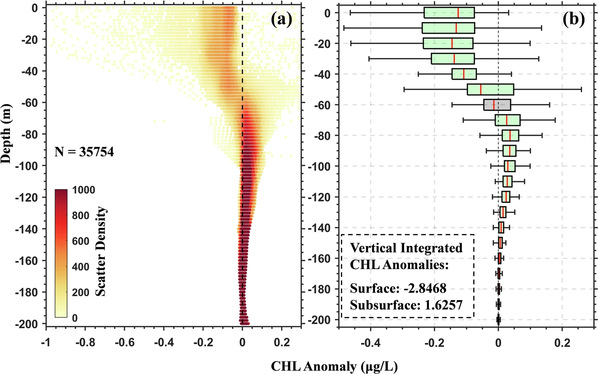
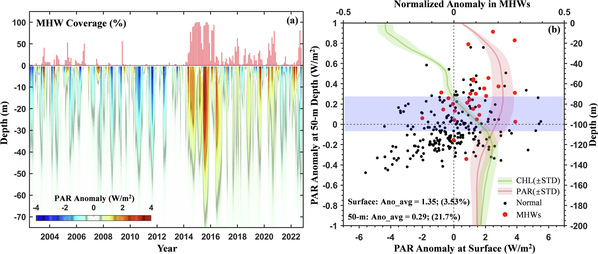
Using 30 years of cruise observation data combined with coupled physical–biogeochemical numerical simulations, the research team revealed the vertical response of phytoplankton in the California Current Ecosystem during marine heatwaves. The study identified a distinct vertical heterogeneity: chlorophyll concentrations significantly decrease at the surface while increasing in the subsurface during heatwave events. The surface decline is mainly attributed to suppressed nutrient upwelling, whereas the subsurface increase is driven by combined changes in light availability and nutrient supply. Specifically, reduced shading by surface phytoplankton increased subsurface light availability by 21.7%, and enhanced onshore nutrient transport promoted deeper phytoplankton growth.
These findings provide new insights into the three-dimensional ecological response and potential resilience of marine ecosystems under heatwave conditions, offering important evidence for evaluating ocean carbon cycle feedbacks in a warming climate. The study also highlights the importance of underwater three-dimensional observations in capturing deep ecosystem responses to extreme climate events.
In recent years, Prof. LI’s team has focused on the development of marine ecological observation equipment and early-warning methods for eco-environmental hazards. Their self-developed cabled seafloor observation systems and sensors are currently operating at 146 sites across China’s coastal, island, and polar regions. The team’s autonomous saildrone “Albatross” completed two typhoon-crossing observation missions in 2025, contributing to advances in ocean–atmosphere process research and forecasting methods.
This paper marks the fifth high-impact publication by the Institute of Physical Oceanography and Remote Sensing at Zhejiang University in Nature Portfolio Earth science journals since 2023, and the second such achievement this year following another publication by Researcher Chundi HU’s team.
(Jian LI, Shuangyan HE)
Original article:https://doi.org/10.1038/s43247-025-02835-8